UFC Live Betting and Real-Time MMA Markets
 Available in US
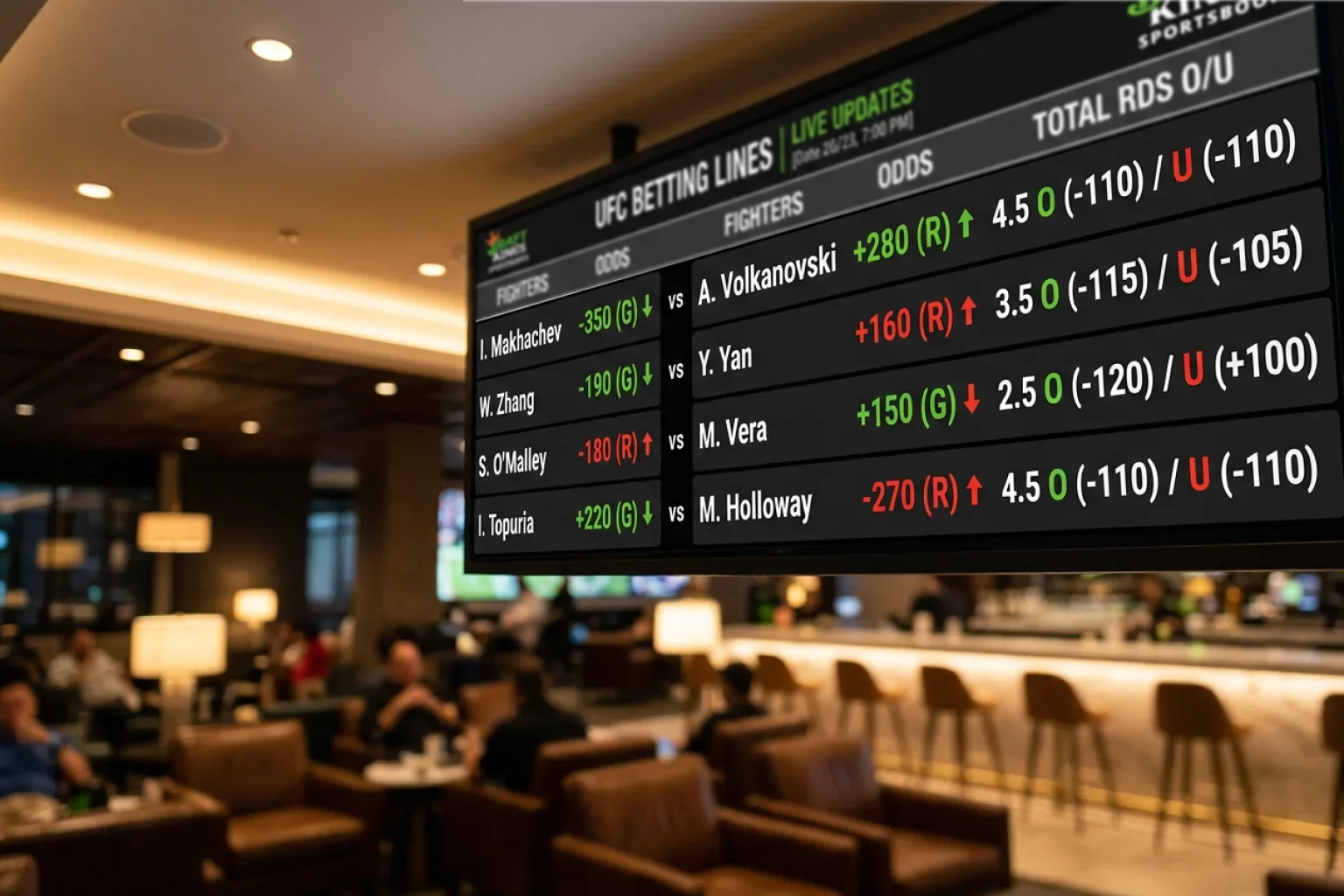
The fight was Islam Makhachev versus Charles Oliveira, and I watched the live odds flip three times in four minutes. Oliveira rocked Makhachev with a right hand in the second round and the in-play line lurched from -300 to -140 within seconds. Then Makhachev secured a takedown, and the number snapped back. That kind of volatility does not exist in football, cricket, or tennis — and it is exactly why UFC live betting has become one of the fastest-growing segments in combat sports wagering.
MMA’s global betting handle hit $10.3 billion in 2024, growing 17% year over year, and a significant slice of that action now happens after the opening bell. The in-play market transforms every round break, every flash knockdown, every failed takedown attempt into a pricing event. For UK punters specifically, this is relatively new territory — live UFC markets were thin just three or four years ago, but the landscape has changed dramatically.
Trip Stoddard of bet365 described the UFC partnership as centred on sports “where live action and fan engagement are inseparable,” and that phrase captures exactly why in-play betting fits MMA better than almost any other format. Fights are short. The action is continuous. And the odds react to what you can see with your own eyes, not to algorithms processing data from a pitch 200 metres away. This guide is built from nine years of placing live UFC bets — the strategies that work, the mistakes that cost me real money, and the mechanical details that separate profitable in-play bettors from everyone else watching the same fight.
To take full advantage of in-play momentum shifts, you need to be registered with the best UK bookmakers for live MMA wagering that offer fast execution.
Table of Contents
- UFC In-Play Betting Mechanics and Live Odds Movements
- Reading the Fight Round by Round
- Momentum Spots That Move the Odds
- Method of Victory Markets During the Fight
- UK Bookmakers and Their Live UFC Coverage
- Execution Tips for In-Play UFC Bets
- Live Betting Pitfalls That Cost Real Money
- Pre-Fight Preparation for Live Betting Success
UFC In-Play Betting Mechanics and Live Odds Movements
I remember my first live UFC bet. I clicked “place bet” during a fight and got a message saying the odds had changed. By the time I accepted the new price, the fight was over. That was 2017. The infrastructure has improved enormously since then, but understanding how it works behind the scenes is essential before you risk a penny.
Live UFC odds are generated by a combination of algorithmic models and human traders. The algorithm processes real-time fight data — significant strikes landed, takedowns completed, control time — and adjusts the probability calculations continuously. Human traders overlay their judgment, particularly during moments the algorithm struggles with: flash knockdowns that look worse than they are, fighters who appear tired but have historically recovered, submission attempts that are close but likely to be escaped.
Between rounds, the markets typically open with adjusted lines reflecting what happened in the completed round. This is the window most live bettors target. The odds are stable for 45 to 60 seconds, giving you time to assess and act. During the round itself, odds move faster and spreads widen — bookmakers protect themselves during chaotic action by increasing the margin between the back and lay prices.
The GGR compound annual growth rate exceeding 18% over the past five years in MMA betting reflects partly how much money has flowed into these live markets. Bookmakers have invested heavily in their in-play UFC products because the margins are higher than pre-fight markets. That margin comes from the speed: you are trading against a system that updates faster than you can think. Acknowledging that asymmetry is the first step toward working around it.
Reading the Fight Round by Round
There is a moment in every UFC fight where the narrative shifts — sometimes subtly, sometimes violently — and the live odds reveal whether the market has caught up to what you are seeing. I have built my entire in-play approach around that gap between observation and price adjustment.
The first round is information gathering. Unless something dramatic happens — a knockdown, a deep submission attempt, a complete grappling shutdown — the first round rarely tells you enough to justify a bet. What it does tell you is how each fighter has chosen to compete. Did the wrestler open with strikes? Did the pressure fighter stay on the outside? Those tactical choices set up the value for rounds two and three.
Round two is where live betting gets interesting. Fighters who dominated round one often see their live odds compress to the point where there is no value backing them further. But if the losing fighter showed competence in a specific area — perhaps they stuffed three takedown attempts or landed clean counters late in the round — the odds against them might be inflated. The market overweights the round result and underweights the process data within that round.
Championship rounds — four and five — produce a different dynamic entirely. Cardio becomes the dominant variable. A fighter who won rounds one through three convincingly might see their live odds shorten to -500 or beyond, but if their output dropped in round three, the fatigue factor is real. I have seen fighters priced at +400 entering round four win three of the last six championship fights I tracked closely. The market prices the scorecard deficit but underprices the physical equaliser that exhaustion creates.
Between rounds, listen to the corners. Most broadcasts include corner audio. A corner saying “you need a finish” tells you they believe their fighter is behind on the cards. That changes the fight’s dynamic completely — the trailing fighter will take bigger risks, which creates both knockout danger and defensive openings. The live odds adjust to the scorecard situation but are slower to price in the tactical shift that corner urgency produces.
Momentum Spots That Move the Odds
Knockdowns are the most dramatic momentum shift in a UFC fight — and the most dangerous moment for live bettors. Here is a scenario I have seen play out dozens of times: Fighter A drops Fighter B with a clean right hand in round two. The crowd erupts. The live odds on Fighter A plummet from -150 to -400 in seconds. Casual bettors pile in. And then Fighter B recovers, clinches, and spends the rest of the round controlling position from the top.
Flash knockdowns — where the hurt fighter recovers within five to ten seconds — create the best live betting value in the entire sport. The algorithm and the public both overreact to the visual spectacle. The odds swing is disproportionate to the actual shift in fight dynamics, particularly when the dropped fighter has a history of recovery. Some fighters absorb damage and come back stronger. Others crumble. Knowing which category a fighter falls into is pre-fight homework that pays dividends in these exact moments.
Takedown sequences produce subtler but equally exploitable swings. When a wrestler secures a takedown against a striker, the odds shift toward the wrestler. But not all control time is equal. A wrestler who holds top position but lands no ground strikes and makes no submission attempts is winning a positional battle that increasingly means less to modern judges. If you know the bottom fighter is comfortable off their back and likely to return to their feet, the live odds after a takedown can offer genuine value on the striker.
Submission attempts create a unique pricing phenomenon. A deep armbar or tight guillotine will swing the odds violently toward the fighter attempting the submission — sometimes to -800 or more for 30 seconds. If the defending fighter escapes, the odds correct, but they rarely snap all the way back. There is a residual fear premium baked into the price. The post-escape window, before the market fully recalibrates, is one of the most consistently profitable micro-opportunities in live UFC betting. You have perhaps 15 to 20 seconds to act on it.
Method of Victory Markets During the Fight
Pre-fight, method of victory markets are priced on historical tendencies. Live, they react to what is actually happening — and the gap between those two things is where some of my best returns have come from.
Consider a fight between a knockout artist and a grappler. Pre-fight, the method markets might price KO/TKO for the striker at +130 and submission for the grappler at +250. Now imagine the grappler wins round one with dominant wrestling and the striker looks unable to stop the takedowns. The live KO/TKO price on the striker drifts out to +300 or beyond. But here is the detail the market is slow to incorporate: desperation changes fighting style. A striker who cannot stop takedowns in the early rounds often commits to heavier single shots in later rounds, throwing with more power and less concern for being taken down. The KO probability in round three might actually be higher than it was pre-fight, even though the overall fight odds have moved against the striker.
Submission markets behave differently. If a fight goes to the ground repeatedly and no submission materialises, the live submission odds tend to drift out — the market assumes that the defending fighter can survive the grappling. That assumption is often correct but occasionally catastrophic. Fatigue degrades submission defence faster than any other skill. A fighter who escaped an armbar in round one might tap to the same armbar in round three because their grip strength has gone. If you spot a fighter’s defensive responses slowing on the ground, the submission line at an inflated price can be exceptional value.
Decision markets are the sleeper. Once a fight reaches round three of a three-round bout without a finish, the decision price should compress dramatically. Sometimes it does. Sometimes the market still carries a finish premium based on both fighters’ historical rates, even though the actual fight you are watching has shown no indication of a stoppage. That discrepancy is easy profit — not exciting money, but the kind that compounds over a full card.
UK Bookmakers and Their Live UFC Coverage
Three years ago, I tried to place a live bet on a UFC prelim and the market simply was not available. The bookmaker offered in-play odds for the main card only — and even those disappeared during the rounds. That experience is largely a thing of the past for UK punters, but the quality of live UFC coverage still varies significantly between operators.
With roughly 10% of the UK adult population betting online, the major bookmakers have invested considerably in their combat sports live products. The UFC’s $7.7 billion deal with Paramount, signed in 2025, guaranteed expanded broadcast coverage across more markets — and where broadcasts go, live betting products follow. The bet365 partnership with UFC, announced in March 2026, specifically emphasised real-time betting as a core element — their in-play UFC markets now cover prelims through to the main event with odds available between rounds and, for major cards, during the action itself. Other UKGC-licensed operators offer varying levels of depth. Some provide live moneyline only. Others include method of victory and round betting in-play. A few offer live props on total significant strikes or whether the fight goes the distance.
What matters for your live betting is not which operator has the flashiest interface but which one offers three specific things: market availability during rounds (not just between them), competitive margins on in-play prices, and reliable execution speed. A beautiful app that takes eight seconds to process your bet is worthless when odds shift every two seconds during a fight. I keep accounts with three operators specifically for live UFC — one as my primary, two as alternatives when the primary’s prices lag or markets suspend during key moments.
Streaming availability also affects live betting quality. Watching via the bookmaker’s own stream introduces a delay of anywhere from 5 to 30 seconds compared to the live broadcast. If you are betting based on what you see on a delayed stream, you are trading on stale information — the odds have already moved. For Fight Night cards versus PPV events, the streaming options and associated delays can differ substantially, which directly impacts your live betting execution.
Execution Tips for In-Play UFC Bets
The difference between a profitable live UFC bettor and someone who just watches fights with an open betting app comes down to preparation and mechanics. I learned this through expensive trial and error over my first two years of in-play wagering, and the lessons were worth every lost pound.
Pre-load your bet slips. Before the fight starts, open the live market on your bookmaker and identify the bets you might want to place. If your plan is to back Fighter B after a first-round loss at inflated odds, have that selection ready. When the moment arrives, you should be clicking “confirm” — not scrolling through markets trying to find the right one. Seconds matter in live betting more than in any other form of sports wagering.
Set your stakes in advance. Deciding how much to bet during a fight is a recipe for emotional staking. You will bet too much after seeing something exciting and too little when the value is actually best. Before the event starts, decide your unit size for live bets and do not deviate. I use the same flat stake for every live bet on a card, regardless of how confident I feel in the moment.
Watch the fight, not the odds. This sounds counterintuitive for betting, but the odds are a lagging indicator of what is happening in the cage. If you are staring at the numbers, you are reacting to the market’s interpretation of the fight rather than forming your own. Watch the action, form your assessment, then check whether the price reflects a different view. The edge lives in that disagreement.
Accept rejected bets gracefully. In fast-moving markets, your bet will be rejected or the odds will change before confirmation. This is not the bookmaker cheating you — it is the reality of pricing a live combat sport. If your bet is rejected, reassess. If the new price still represents value, resubmit. If it does not, walk away from that particular opportunity. There will be another one within minutes.
Live Betting Pitfalls That Cost Real Money
My worst live betting night cost me four weeks of profit in about 90 minutes. I chased. Every fight, I had a position, and every fight, the position went wrong early. Instead of stepping back, I doubled down live — telling myself I was “getting value” when I was really just refusing to accept the loss. That evening taught me more about discipline than any profitable month ever has.
Chasing is the primary killer. A pre-fight bet loses, and the temptation to recover that loss through a live bet on the next fight is overwhelming. The problem is that chasing bets are not made from analysis — they are made from emotion. You are not evaluating whether the live odds represent value. You are looking for a vehicle to erase the previous loss. Those are fundamentally different activities, and the results reflect it.
Overreacting to single moments is the second trap. A fighter gets rocked, and you assume the finish is coming. But odds near pick’em ranges — between +100 and -122 — land at roughly 51% accuracy. Many fights that look one-sided after a single sequence end up being competitive. The visual drama of a knockdown or a deep submission attempt triggers an urgency response that is useful for survival but terrible for betting. Train yourself to wait 30 seconds after any dramatic moment before acting. If the value is real, it will still be there.
Betting every fight is the third mistake. A 14-fight UFC card does not mean 14 live betting opportunities. On a typical card, I might place two or three live bets — sometimes none. The discipline to sit through a fight without wagering, even when you have an opinion, is what separates a strategy from a habit. Underdogs priced at +200 and above won 39% of the time in 2024 — but that figure includes all fights, not just the ones where live odds offered genuine value. Being selective is not passive. It is the active part of the strategy.
Stay ahead of the oddsmakers by utilizing the tools provided by our premier UFC betting platform during every fight night.
Pre-Fight Preparation for Live Betting Success
The best live bet I ever placed was decided 48 hours before the fight started. I had studied the matchup, identified a specific scenario — one fighter fading in round three against a pressure wrestler — and wrote down the exact conditions under which I would bet. When those conditions materialised on fight night, I placed the bet in under five seconds. No hesitation, no second-guessing. That speed came from preparation, not instinct.
Your pre-fight prep for live betting is different from standard fight analysis. You are not just predicting who wins — you are mapping out how the fight might unfold and identifying the points where the market is likely to misprice the situation. For each fight you plan to watch live, write down three things: the most likely fight dynamic, the scenario where the underdog has a realistic chance, and the round or moment where you expect the odds to offer value.
Research sites provide the statistical foundation. As one UFC betting guide put it, platforms like Tapology offer punters comprehensive statistics about almost any fighter — and that data becomes your edge when the fight goes live. Pull up each fighter’s round-by-round statistics. Some fighters are historically slow starters who improve as the fight progresses. Others fade after the first round. That pacing data is what lets you anticipate the live odds movement before it happens, rather than reacting to it.
Build a fight card cheat sheet. For each bout, note: each fighter’s finishing rate, their average fight time, their recent form trajectory, and any stylistic elements that create clear momentum-shift scenarios. Keep this physical or on a separate screen during the event. When the action is fast and the odds are moving, you will not have time to research — you need the data at your fingertips already.
Finally, decide your total live betting budget for the card before it begins. Not per fight — for the entire event. This cap prevents the incremental creep that turns a disciplined session into a binge. If you have allocated GBP 50 for live bets across a 14-fight card and you have spent GBP 40 by the co-main event, you have one bet left. That constraint forces selectivity, which is the quality that matters most for any live bettor. The favourites win 65.48% of the time across a decade of UFC data — but knowing when the other 34.52% is being mispriced in real time is what makes live betting worth the effort.
Can I cash out a UFC bet mid-fight?
Some UK bookmakers offer partial or full cash-out on live UFC bets, but availability depends on the operator and the specific market. Cash-out values are calculated from the current live odds, so they fluctuate rapidly during a fight. Be aware that the cash-out price always includes a margin — you will receive less than the theoretical value of your position. Use cash-out when your pre-fight thesis has been invalidated, not as a profit-taking habit.
How fast do live UFC odds update?
Between rounds, odds are typically stable for 45 to 60 seconds while traders set new lines. During rounds, odds can shift every two to five seconds based on significant strikes, takedowns, and position changes. The speed varies by bookmaker — some use more aggressive algorithmic pricing that updates almost continuously, while others rely on manual trader input and update less frequently.
Is live UFC betting more profitable than pre-fight betting?
Live betting offers different opportunities, not inherently better ones. The margins are higher on live markets, which works against you. But the ability to react to information the pre-fight odds could not account for — a fighter looking sluggish in the warm-up, an unexpected tactical approach, a momentum shift after a flash knockdown — creates value windows that do not exist pre-fight. Profitable live bettors tend to be highly selective, placing far fewer bets per card than they would pre-fight.
Created by the ”ufc Fighter Betting” editorial team.